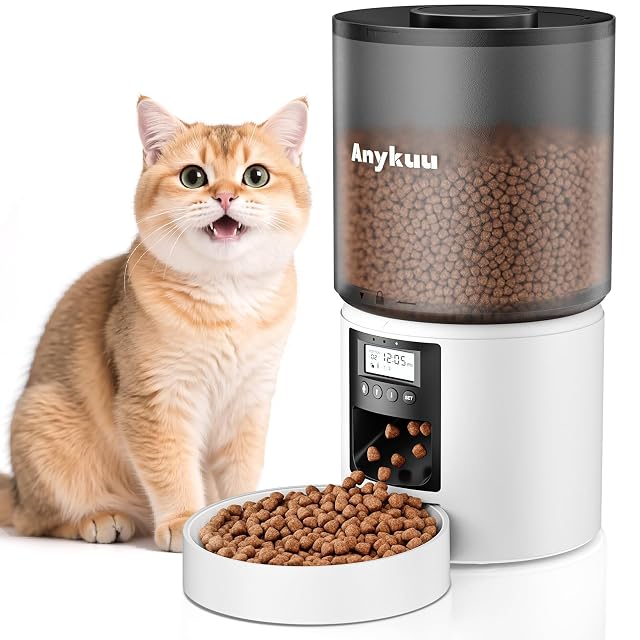
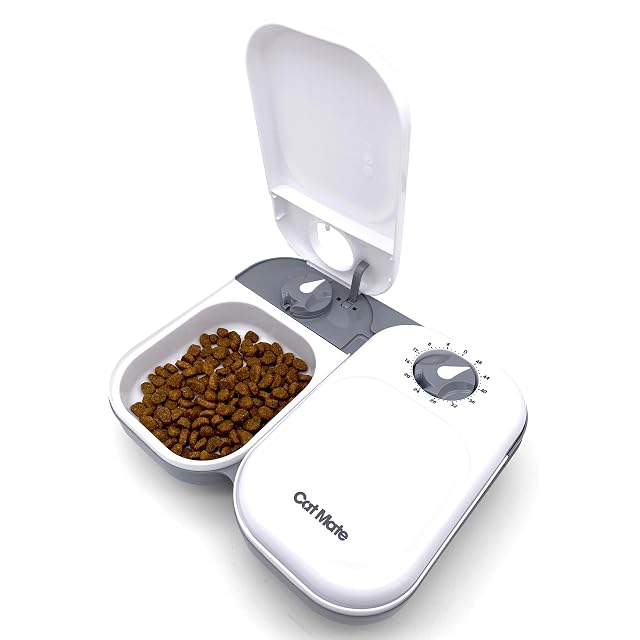
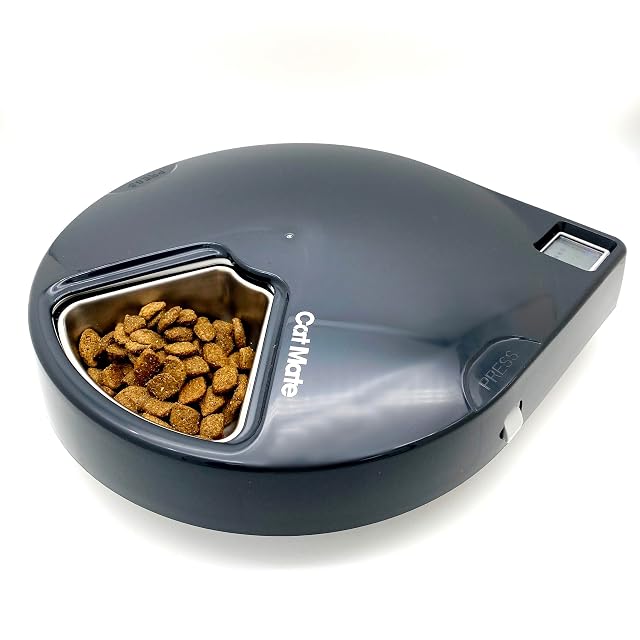
What you are getting
A 5 L / 20 cup hopper, app scheduling and manual feeding, a feeding log, 5 GHz or 2.4 GHz Wi-Fi, and a 10-second voice recording played before each meal. Stated to feed two adult cats for ten days on a full tank. $69.99.
It prints the figure this shelf says nobody prints
The introduction to this page names it: the specification that matters on a feeder is which kibble sizes it will not jam on, and almost no listing gives it.
This one does, twice over:
- “Allowed kibble size less than 0.5 inch” — under 12.7 mm (0.50 in)
- “1 Portion ≈ 10 Grams ≈ 1/12 Cup”
The second is rarer than the first. Every feeder on this shelf counts portions, and a portion is a rotor turn; this is the only listing in the American survey to convert that turn into grams. It is what makes a vet’s instruction — “ninety grams a day, split in three” — something you can actually program.
Compare the PETLIBRO on this page, which takes 2–15 mm (0.08 to 0.59 in) kibble and never says what a portion weighs.
5 GHz, which almost nothing here supports
“oneisall automatic cat food dispenser can connect to 5G/2.4G Wi-Fi. Compared to 2.4G Wi-Fi, this feeder with 5G feature would connect to network more stably.”
Of the devices surveyed across this site’s machine shelves, the great majority are 2.4 GHz only. A feeder that joins a 5 GHz network is one that works on a modern mesh router without hunting for a legacy band — a small thing until the day it is not.
Fairness between two bowls, stated plainly
“This cat feeder would deliver the same amount of food to each bowl. 100% fair for each lovely pet.”
That is a splitter promise, not an identification promise. It divides the ration evenly; it has no idea which cat eats which half. For that, the smart bowls shelf on this site has an RFID feeder that locks the lid.
Ten days, for two cats
The figure given is “a full tank of dry food allows 2 adult cats to eat for 10 days” — about 250 g (8.8 oz) a day between them, which is consistent with 5 L of kibble. No figure is given for one cat or for three.
The voice recording, and what it is for
Ten seconds, played before each meal. It is the feature every feeder on this shelf has and none explains: a recorded call trains the animal to associate the sound with food, which means it comes to the bowl rather than finding it hours later with the kibble stale.
What is not published
No jam behavior, no battery backup, no power-cut behavior, no hopper seal or desiccant, and no weight for the unit’s own portions beyond the ≈ 10 g figure. The feeders shelf judges three things — portion consistency, hopper seal and what happens in a power cut — and this listing answers only the first.
The PETLIBRO on this page publishes a desiccant, a sealing strip and a battery backup, and charges thirty dollars more for them.
Availability
Read on the day this page was built: $70 at the American Amazon shop.
Read from Keepa on the day this page was last revised; stock and price both move without notice.
Prices quoted in this text were read on 2026-10-06. The live price is at the top of the page.