Skip to content

The best pet grooming vacuums for 2026

A grooming vacuum is a clipper, a deshedding comb and a brush that all empty into a canister instead of into the room. It is the fastest-selling family on this site, and the one where the specification sheet misleads most often: suction in kPa is quoted at the motor, not at the comb, and a long thin hose loses a great deal of it. We compare stated suction, stated noise, bin size, and which attachments are still in use after the first month.

The models we recommend

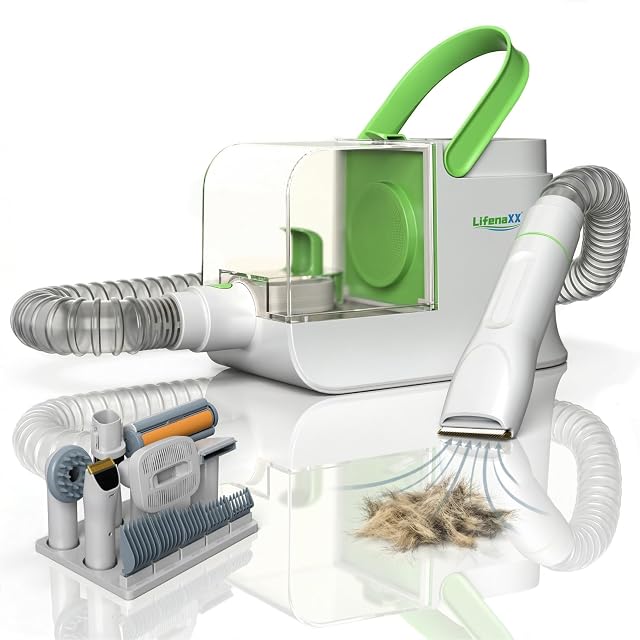
  1. Lifenaxx LX-052

    12,000 Pa · 1.5 L bin · under 75 dB · washable HEPA filter

    A 6-in-1 kit whose clipper runs off the vacuum unit rather than its own battery, with a washable HEPA filter and six guide combs from 3 to 24 mm (0.12 to 0.94 in).

    Best for: Households where the vacuum will be used regularly and stored between sessions — the filter washes, and there is no battery quietly aging in a drawer.
    7.9/10

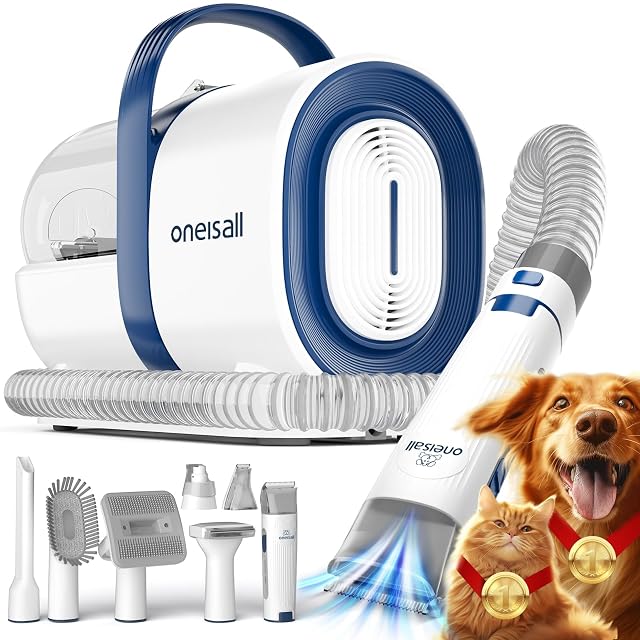
  2. oneisall LMC5 7-in-1

    12,000 Pa · 1.5 L bin · 60 dB · six guide combs 3–23 mm (0.12 to 0.91 in)

    The highest suction figure in this group at 12,000 Pa, across three levels, with six guide combs from 3 to 23 mm (0.12 to 0.91 in) and a stated 60 dB. Sold on all six of our markets.

    Best for: A long-coated dog: the 18 and 23 mm (0.91 in) combs are what the other kits in this group do not have.

    7.9/10

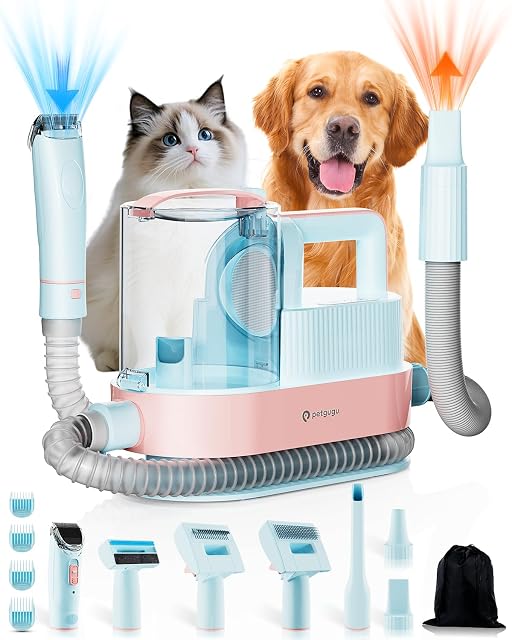
  3. PETGUGU M1 Pro

    11,000 Pa · 2.5 L bin · under 62 dB · built-in warm-air dryer

    The best-documented grooming kit here: 11,000 Pa of suction, a 2.5-liter bin, a stated noise figure and a warm-air dryer with three temperature steps, all in one 7-in-1 set.

    Best for: A first grooming vacuum for a dog that tolerates noise, where the built-in dryer replaces a second machine.

    7.9/10

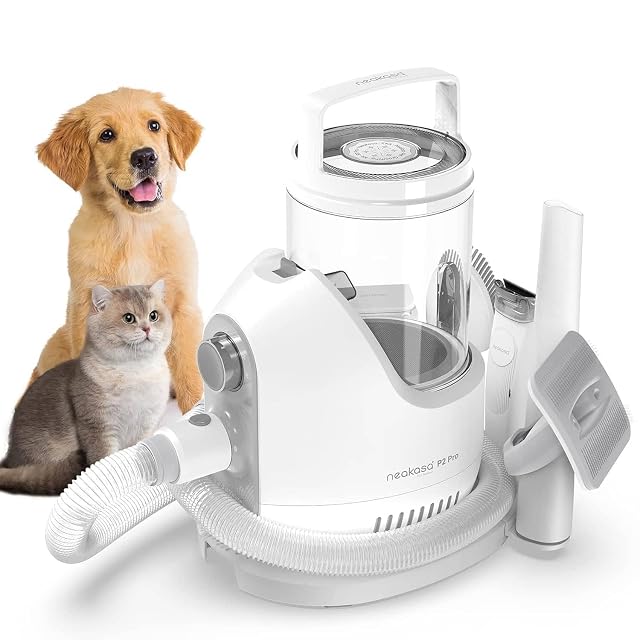
  4. Neakasa P2 Pro

    5-in-1 grooming kit · listing carries no published specification

    Neakasa’s 5-in-1 grooming vacuum kit for dogs and cats. It is the best-known machine in this family, and its Amazon listing is also the least documented one on this page — a gap we state rather than fill.

    Best for: Someone who already knows this model and wants to buy it on the right market — not someone comparing specifications, because there are none to compare.

    7.7/10

Finding your need in grooming vacuums

Handling a dense coat

Suction power decides whether the hair is captured or scattered across the room. That is the entire argument for this format.

Lifenaxx LX-052

Not frightening the animal

Noise is what sends a dog or a cat running. A powerful machine you cannot actually use is worth nothing.

oneisall LMC5 7-in-1

Covering several uses

The number of attachments decides what the machine can do: brush, clip, detangle, vacuum surfaces.

Lifenaxx LX-052

The buyer behind each kind, in grooming vacuums

Shedding season
This is when the machine earns its keep: the amount of hair captured rather than scattered is spectacular.
Animal used to noise
Acceptance decides everything. An animal that tolerates the vacuum cleaner will take to this machine more readily.
Nervous animal
Quiet mode and gradual habituation, machine switched off to begin with, are the only approach that works.

The downsides that come with grooming vacuums

Suction against noise
The stronger the suction, the louder the machine. That is the central trade-off here, and noise usually wins in practice.
Canister capacity against bulk
A large canister avoids emptying mid-session and adds weight at the end of the hose. Some models plug into an existing vacuum cleaner.
Dedicated machine against vacuum attachment
An attachment fitted to an ordinary vacuum costs far less and is markedly louder. The dedicated machine is designed to be bearable.

The questions people ask about grooming vacuums

How do I get an animal used to the machine?

In stages: present it switched off, then running at a distance, then brief contact, over several sessions. Forcing ruins acceptance for good.

Does it replace brushing?

The machine brushes and captures hair at the same time. On a badly matted coat you must detangle by hand first.

Can it clip?

Some models have a clipping head with integrated suction. Cut quality is generally below that of a dedicated clipper.

Does it suit every coat?

Long and curly coats need specific attachments and prior detangling. Short coats are the easiest.

How often should it be used?

Several times a week during shedding, less often the rest of the year. The rhythm depends on the breed and the season.

How do you clean a grooming vacuum?

Empty the canister after each session and clean the filters regularly. A filter clogged with hair kills the suction.

Does it vacuum floors too?

Most offer attachments for that. The power stays below that of an ordinary vacuum cleaner.

Does the bin empty without sending the hair back into the air?

Bins that open from the base drop their contents into a bag without your hand going in. With a lidded bin, a dog's moult rises back into the room at every emptying.

Worth remembering, on grooming vacuums

Noise decides real-world use far more than suction: a powerful machine the animal refuses is worth nothing. Habituate in stages, switched off first, detangle before vacuuming a long coat — and empty the filters, a clogged filter kills all suction.

Grooming vacuums in brief

  • Noise: 60 to 75 dB (Lifenaxx figure), on 3 of the 4 models.
  • Suction: 11,000 to 12,000 Pa maximum — ≥3, on 3 of the 4 models.

Grooming vacuums, side by side

There is no table here, and the reason is in the listings. The figure published most often across these 4 products is guide combs, given by 3 of them — short of the four in five a column needs to compare rather than to display gaps. Each product page says what its own maker published.

The guides that discuss grooming vacuums

Sources, and how we decide

Specifications: manufacturer sheets for pet devices and the matching Amazon product pages. Prices and availability: Keepa.

Most recent revision in this category: August 17, 2026.

The way we judge grooming vacuums