Skip to content

The best grooming vacuum for a shedding dog

A grooming vacuum is a clipper and a comb that empty into a canister instead of into the room. The specification that decides whether it gets used is noise, and only some makers publish it.

Noise decides whether it gets used

Every kit here quotes between 60 and 75 dB. That is a real spread, and on a dog that has been startled once it is the difference between a tool you use weekly and one that lives in a cupboard. Introduce any of them running in another room first.

Bin size decides how long a session runs

Between 1.5 and 2.5 liters across these three. On a large dog in full moult the smaller bins fill mid-session, which is an interruption at exactly the wrong moment.

The one we cannot rank

The best-known machine in this family publishes no suction, no noise and no capacity. Its review says so, and it is not in this guide for that reason.

Which one suits your animal?

Your dog tolerates noise well
A grooming vacuum captures hair at source and it is genuinely transformative for a heavy shedder.
Your dog is noise-sensitive
The quietest model you can find, introduced slowly, or an ordinary brush outdoors instead.
You already own a vacuum
A grooming attachment kit may fit it, and that costs far less than a dedicated unit.
You groom several animals
Capacity and filter access matter, because you will empty it mid-session.

Picking by the animal

Heavy seasonal shedding

Where a grooming vacuum earns its place: the hair goes into the machine rather than onto the floor.

Routine brushing

Possible, but many owners find a plain brush faster for a quick daily pass.

Clipping

Some units combine clipper and suction, which keeps cut hair out of the room. A useful combination if the animal accepts it.

Cleaning up afterwards

Most units double as a small vacuum for the bed, the sofa and the car.

The points that make the difference

Noise level
The single factor that decides whether the machine gets used. A dog that will not stand near it makes every other specification irrelevant.
The attachments included
Deshedding head, clipper, nozzle. The heads are what do the work, and one that suits your dog's coat is what matters.
Suction and its adjustability
Too little does not pull loose hair; too much is uncomfortable on skin. Adjustment is more useful than a high figure.
Capacity and emptying
A heavy moult fills a small canister quickly. Emptying mid-session is normal; a design that makes it messy is not.
Filter type and access
Hair and dander clog filters. A filter you can reach and rinse keeps the suction; a sealed one degrades quietly.

Which figure for which animal

Your dogWhat to prioritizeWhat to expect
Heavy shedder, tolerantDeshedding head and capacityMuch less hair in the house
Noise-sensitiveThe quietest modelSlow introduction needed
Long or curly coatA head that suits the coatMats still need a comb
Several animalsCapacity and filter accessEmptying mid-session

What owners get wrong

Introducing it at full power on day one
A frightened dog will never accept the machine afterwards. Running it in the room, then off the body, then briefly on, is the approach that works.
Using it on a matted coat
Suction and a deshedding head pull at mats. Mats are dealt with by comb, scissors or a groomer first.
Ignoring the filter
A clogged filter kills suction, and people conclude the machine is weak. It is the maintenance item nobody reads about.
Expecting it to replace brushing entirely
It removes loose hair well; it does not check skin or work through a coat the way a comb does.

By the household and the animal

The heavy shedder's household
A grooming vacuum with a good deshedding head. It changes how much hair ends up on the floor.
The nervous dog
The quietest option, introduced over weeks, or an ordinary brush used outdoors.
The owner who already vacuums
A grooming attachment kit for an existing vacuum, which does most of the job for far less.

Cleaning, refills and working life

A grooming vacuum fills with hair and dander, which is exactly what clogs filters and coats the inside of hoses. Suction loss is almost always maintenance rather than a fault, and it happens gradually enough that people do not notice until it stops working.

  • Empty the canister after each session rather than when it is full.
  • Rinse or replace the filter on the schedule the machine specifies.
  • Check the hose for a hair blockage when suction drops.
  • Clean the attachment heads; hair wraps around them and reduces contact.

Safety

The concerns are the animal's comfort and the skin.

  • Never use suction on broken skin, wounds or hot spots.
  • Keep the nozzle moving rather than holding it in one place.
  • Introduce the machine gradually and stop if the animal is genuinely distressed.
  • Keep the power cable away from a dog that chews.

Our picks, and what decided each

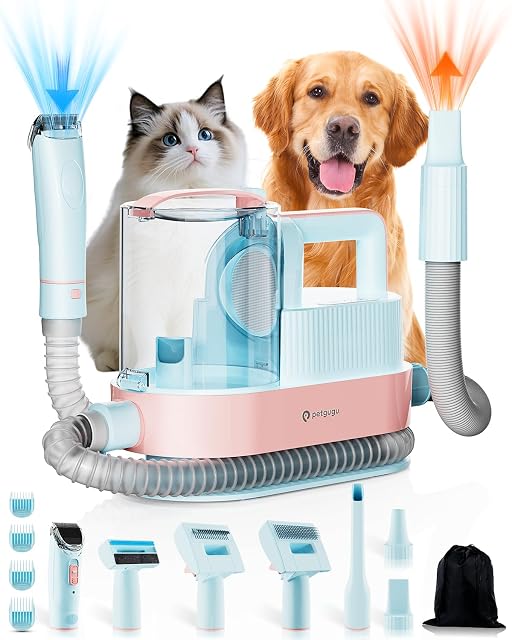
  1. PETGUGU M1 Pro

    11,000 Pa · 2.5 L bin · under 62 dB · built-in warm-air dryer

    The best-documented grooming kit here: 11,000 Pa of suction, a 2.5-liter bin, a stated noise figure and a warm-air dryer with three temperature steps, all in one 7-in-1 set.

    Best for: A first grooming vacuum for a dog that tolerates noise, where the built-in dryer replaces a second machine.
    7.9/10

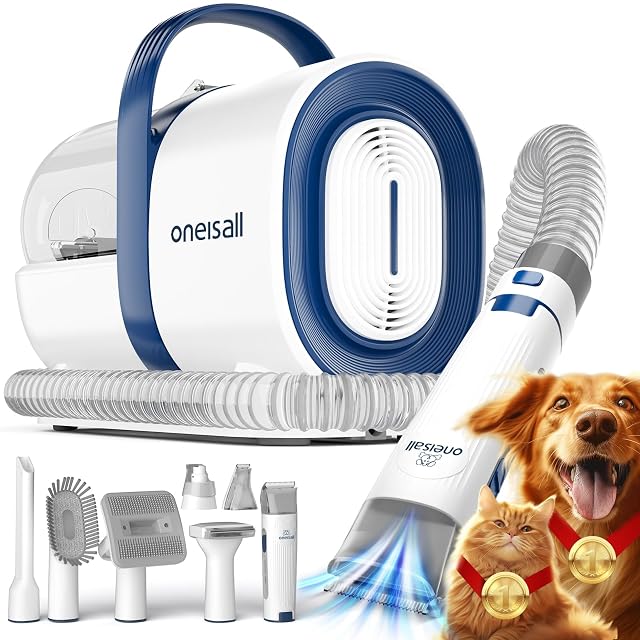
  2. oneisall LMC5 7-in-1

    12,000 Pa · 1.5 L bin · 60 dB · six guide combs 3–23 mm (0.12 to 0.91 in)

    The highest suction figure in this group at 12,000 Pa, across three levels, with six guide combs from 3 to 23 mm (0.12 to 0.91 in) and a stated 60 dB. Sold on all six of our markets.

    Best for: A long-coated dog: the 18 and 23 mm (0.91 in) combs are what the other kits in this group do not have.

    7.9/10

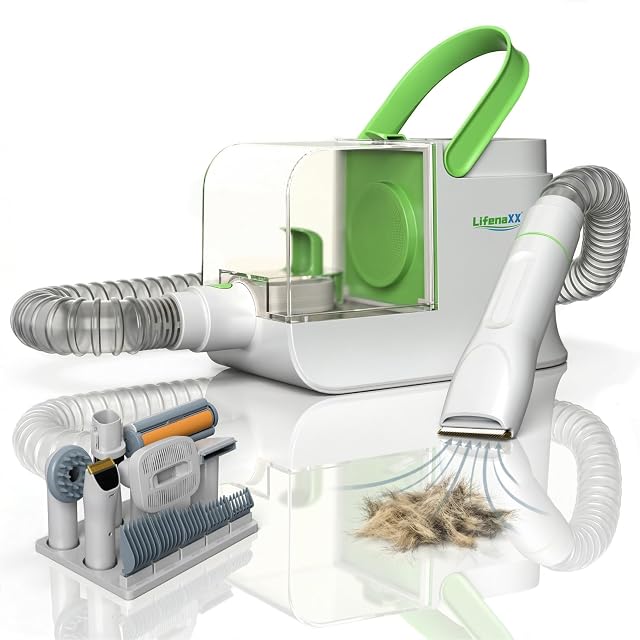
  3. Lifenaxx LX-052

    12,000 Pa · 1.5 L bin · under 75 dB · washable HEPA filter

    A 6-in-1 kit whose clipper runs off the vacuum unit rather than its own battery, with a washable HEPA filter and six guide combs from 3 to 24 mm (0.12 to 0.94 in).

    Best for: Households where the vacuum will be used regularly and stored between sessions — the filter washes, and there is no battery quietly aging in a drawer.

    7.9/10

The questions owners ask

How much suction do I need?

Less than the marketing suggests. The figures here run from 11,000 to 12,000 Pa at the motor, and a long thin hose loses much of it at the comb. Start on the lowest setting that collects hair — the pull and the noise are what frighten animals.

Will it replace a trip to the groomer?

For maintenance between visits, largely. For a matted coat, no: mats sit against skin you cannot see and have to be cut out by someone who can.

Will my dog tolerate a grooming vacuum?

Many do, with a slow introduction. Some never will, and for a genuinely noise-sensitive dog an ordinary brush used outdoors is the better answer.

Does it replace brushing?

It removes loose hair very well but does not work through a coat or let you check the skin the way a comb does. It complements brushing rather than replacing it.

Why has the suction dropped?

Almost always a clogged filter or a hair blockage in the hose. It is maintenance rather than a fault, and it happens gradually.

Can I use it on a matted coat?

No. Suction and a deshedding head pull at mats and hurt. Mats need combing out, cutting or a groomer first.

Can I use my normal vacuum with an attachment kit?

Often yes, and it costs far less than a dedicated unit. Whether it works well depends on your vacuum's suction and noise.

How do I introduce it to a nervous dog?

Run it in the room without touching the dog, then near it, then briefly on the body. Rushing this stage is what makes a dog refuse the machine permanently.

Each product, and the animal it was chosen for

PETGUGU M1 Pro

For the animal that: A first grooming vacuum for a dog that tolerates noise, where the built-in dryer replaces a second machine.

Its main plus: Publishes every figure that matters in this family — suction, noise, bin, hose lengths

Its main minus: 62 dB is not quiet for a machine held against a nervous dog — the quietest clippers here are under 50 dB

Read the full review →

oneisall LMC5 7-in-1

For the animal that: A long-coated dog: the 18 and 23 mm (0.91 in) combs are what the other kits in this group do not have.

Its main plus: Six guide combs up to 23 mm (0.91 in) — the widest range here, and the only one that suits a long coat

Its main minus: A 1.5 L bin against the PETGUGU’s 2.5 L — more emptying on a big dog

Read the full review →

Lifenaxx LX-052

For the animal that: Households where the vacuum will be used regularly and stored between sessions — the filter washes, and there is no battery quietly aging in a drawer.

Its main plus: Washable HEPA filter rather than a consumable cartridge

Its main minus: Under 75 dB is the loudest stated figure in this group

Read the full review →

What else you will need

Refills, liners and spares from the same aisle, at the price we read. Confirm they suit the product you choose before ordering: it turns on the model and the part number, which the listing gives.

Comparisons that help you decide

Direct comparisons already published between two products from this guide or this aisle.

What this list is based on

The products above are drawn from the catalog of this site. Specifications are those the manufacturer and the Amazon listing publish; prices are what Keepa recorded on the date shown, and both move. The order uses declared specifications, stated strengths set against stated limits, and price. Nothing here has been given to an animal by us, and the page makes no such claim.

Last checked on

Prices quoted in these summaries are dated readings. The live price is shown next to each product.

The tool we use ourselves

Chosen your machine? Now buy it at the right price.

Litter boxes and grooming vacuums swing by a hundred dollars or more across the year, and the biggest "discounts" often land at prices the same model sold for six weeks earlier. UniverTrack tracks the real price history across retailers, spots fake reductions, and alerts you when it is genuinely the moment to buy.

Real price historyBuy-now alertsAI buying assistant
Try free for 14 days →
No commitment · Cancel in one click · 5 languages