Skip to content

The best pet dryer for a thick coat

A pet dryer moves water out of a coat with air rather than heat. Which of these two you need is decided by the size of the animal, not by the price.

Airflow, not heat

A blaster pushes water out of the undercoat mechanically. That is why a 3,200 W machine on a low temperature dries faster and more safely than a hot hairdryer — the power is moving air, not making heat.

Match the machine to the animal

A cat or a small dog does not need a blaster, and will not tolerate the noise. A soaked Bernese is not going to be dried by 900 watts before both of you lose patience.

The rule that applies to both

Keep the nozzle moving, never park it on one spot, and follow the maker’s stated session limits. A coat holds heat against skin you cannot see.

Which one suits your animal?

Your animal has a thick double coat
A force dryer blows water out of the coat, which a heat dryer cannot do in reasonable time.
Your animal is noise-sensitive
Noise is the deciding factor, and a quieter, lower-power unit used patiently is the compromise.
You dry a small or short-coated animal
A towel and time may genuinely be enough, and a dryer is an unnecessary stress.
You groom professionally or often
Power, duty cycle and hose quality become the criteria rather than price.

Picking by the animal

After a bath

The core use. A thick coat left damp stays damp for hours and can develop skin problems.

After rain or swimming

Where a quick blast beats towelling, especially in winter.

Blowing out loose undercoat

A force dryer removes loose hair remarkably well, which is a real secondary benefit.

Straightening before clipping

A groomer's use, and one reason professional units are built the way they are.

The points that make the difference

Force dryer or heat dryer
A force dryer moves air and pushes water out; a heat dryer evaporates it. On a thick coat the first is far faster and much safer for the skin.
Heat control
Animals do not tolerate hot air the way people do, and a hot dryer on skin is a burn risk. Ambient or gently warmed air is the safe setting.
Noise
The reason most animals refuse. It is the single specification that decides whether the machine ever gets used.
Hose length and nozzles
A long hose means the motor sits away from the animal, which reduces the perceived noise considerably.
Motor duty and airflow
Airflow does the work. A weak unit takes so long that the animal's patience runs out before the coat dries.

Which figure for which animal

The coatThe dryerThe caution
Thick double coatForce dryerNoise is the obstacle
Short coatA towel may doA dryer may be needless stress
Curly coatForce dryer with brushingDrying alone leaves it matted
Any coatAmbient or gentle warmthHot air burns skin

What owners get wrong

Using a human hairdryer
They run hot and are designed for scalp distance and human tolerance. On an animal's skin the burn risk is real and the airflow is too weak for a thick coat.
Aiming at the face and ears
High-velocity air into eyes and ears is distressing and can cause harm. Those areas are towelled, not blown.
Introducing it at full power
As with grooming vacuums, a frightened animal refuses permanently. Start with the machine on and directed away.
Drying a curly coat without brushing
Curly coats mat as they dry. Brushing while drying is part of the method, not an optional extra.

By the household and the animal

The double-coated dog
A force dryer with a long hose, used at ambient or gentle warmth, introduced gradually.
The noise-sensitive animal
The quietest unit available, the hose extended, and patience across several sessions.
The short-coated pet
Often a towel and a warm room. A dryer here solves a problem that may not exist.

Cleaning, refills and working life

A pet dryer draws air through a filter and pushes it through a hose, so hair and dander are what limit it. A clogged filter reduces airflow and makes the motor work harder, and that is the commonest cause of a dryer that seems to have weakened.

  • Clean or replace the air filter regularly; it clogs faster than people expect.
  • Check the hose for splits and for hair trapped inside.
  • Let the motor cool between long sessions rather than running it continuously.
  • Store the hose without tight kinks, which is where it fails.

Safety

Heat and high-velocity air are both genuine hazards to an animal.

  • Use ambient or gently warmed air; hot air burns skin under a thick coat before you notice.
  • Never direct the airflow into eyes, ears or nose.
  • Never leave an animal unattended with a dryer running.
  • Stop immediately if the animal is genuinely distressed rather than merely unimpressed.

Our picks, and what decided each

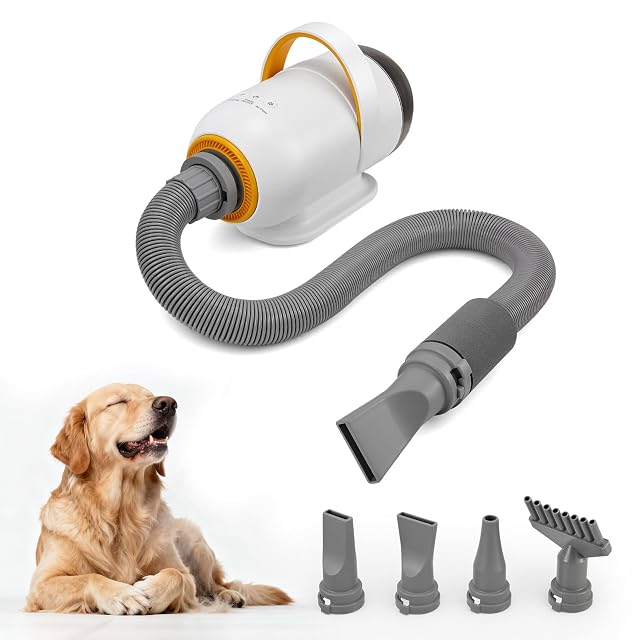
  1. Hoyiyobi 3200 W blower

    3,200 W · 7 heat settings · four nozzles · with suction

    A 3,200-watt blaster with seven temperature settings, four interchangeable nozzles and a suction function. It is the machine for a large, wet, double-coated dog.

    Best for: A large, thick-coated dog after a bath — the case where a household hairdryer takes an hour and this takes fifteen minutes.
    7.8/10

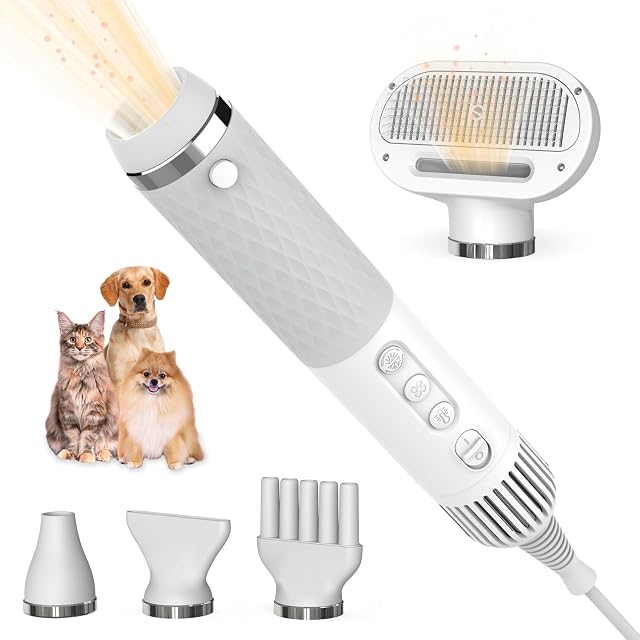
  2. KUUBIA 5-in-1,900 W

    900 W · four nozzles · 4 heat steps 30–80 °C (86 to 176 °F) · ionic

    A 900-watt dryer with four nozzles, three wind speeds and four heat settings from 30 to 80 °C (86 to 176 °F), plus an automatic temperature cycle. It doubles as a brush.

    Best for: A small or medium dog, or a cat that tolerates air, where knowing the actual temperature matters more than raw power.

    7.8/10

The questions owners ask

Is a household hairdryer really that bad?

It dries the top of a coat and leaves the undercoat damp, and it has no low-temperature setting worth the name. The heat is also concentrated, which is the opposite of what you want near skin you cannot see.

Which temperature should I use?

The lowest that dries in reasonable time, kept moving. Both machines here publish their steps in degrees, which is why they are the ones in this guide.

Can I use a human hairdryer?

It is not advisable. They run hot enough to burn skin under a coat and lack the airflow a thick coat needs, so drying takes far too long.

What is a force dryer?

A dryer that pushes water out of the coat with high-velocity air rather than evaporating it with heat. On a thick coat it is far faster and safer for the skin.

How do I get my dog used to it?

Run it in the room without pointing it at the animal, then briefly on the body, and build up. Rushing this is what makes an animal refuse permanently.

Is heat necessary?

No, and it is the risky part. Ambient or gently warmed air dries a coat safely; hot air can burn skin you cannot see under the fur.

Can I dry the face with it?

No. High-velocity air into eyes, ears and nose is distressing and can cause harm. Those areas are towelled instead.

Why has my dryer lost power?

Almost always a clogged air filter or hair in the hose. It is routine maintenance rather than a fault.

Each product, and the animal it was chosen for

Hoyiyobi 3200 W blower

For the animal that: A large, thick-coated dog after a bath — the case where a household hairdryer takes an hour and this takes fifteen minutes.

Its main plus: The only machine here with the airflow to dry a large double coat quickly

Its main minus: A 3,200 W blower is loud, and Hoyiyobi publishes no noise figure

Read the full review →

KUUBIA 5-in-1,900 W

For the animal that: A small or medium dog, or a cat that tolerates air, where knowing the actual temperature matters more than raw power.

Its main plus: Publishes its temperatures in degrees rather than as "low, medium, high"

Its main minus: 80 °C (176 °F) at the nozzle is hot: that setting is for the far end of a thick coat, not for skin

Read the full review →

What else you will need

Refills, liners and spares from the same aisle, at the price we read. Confirm they suit the product you choose before ordering: it turns on the model and the part number, which the listing gives.

What this list is based on

The products above are drawn from the catalog of this site. Specifications are those the manufacturer and the Amazon listing publish; prices are what Keepa recorded on the date shown, and both move. The order uses declared specifications, stated strengths set against stated limits, and price. Nothing here has been given to an animal by us, and the page makes no such claim.

Last checked on

The tool we use ourselves

Chosen your machine? Now buy it at the right price.

Litter boxes and grooming vacuums swing by a hundred dollars or more across the year, and the biggest "discounts" often land at prices the same model sold for six weeks earlier. UniverTrack tracks the real price history across retailers, spots fake reductions, and alerts you when it is genuinely the moment to buy.

Real price historyBuy-now alertsAI buying assistant
Try free for 14 days →
No commitment · Cancel in one click · 5 languages