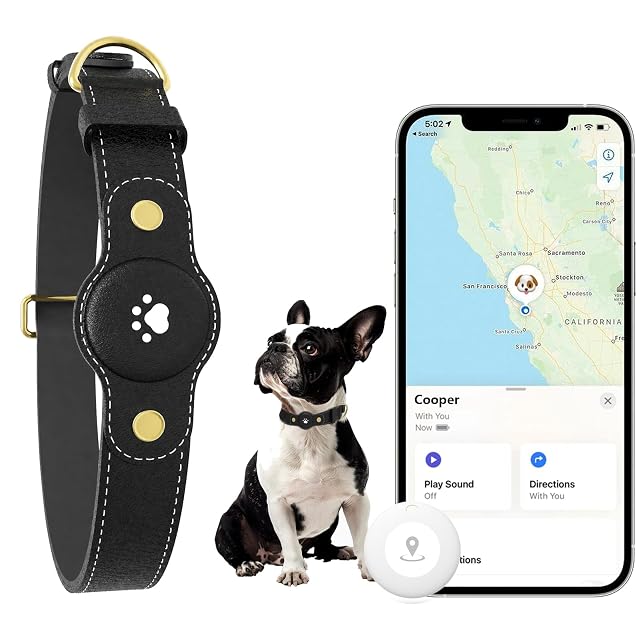
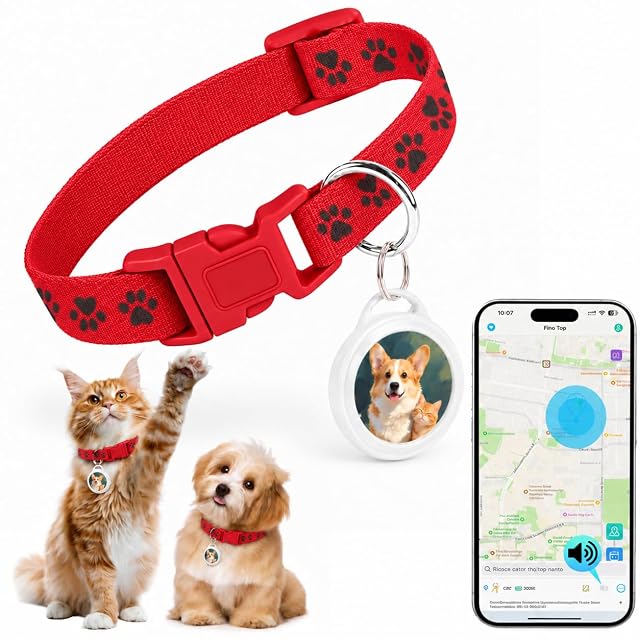
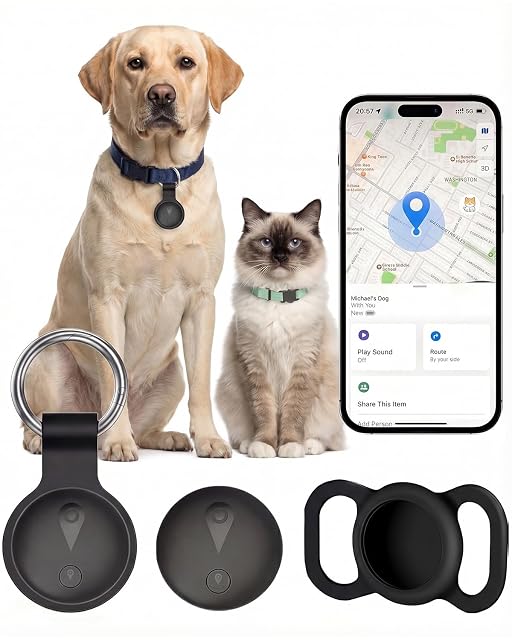
What we take from it Among the cheapest devices in this group — a dollar above its own iPhone twin — and the only one of the five American no-SIM devices that says plainly what it is: no satellite GPS, a Bluetooth tag that appears in Google Find Hub when an Android phone walks past. The honesty is worth more than the eighteen dollars.
What you are getting
A 10 gram Bluetooth tag on a breakaway collar, running 12 months on one CR2032 cell, rated IP67, reported through Google Find Hub. Android only. $17.99.
It tells you what it is, and nothing else here does
Fourth bullet, in the maker’s own words:
“This dog gps does NOT have standalone satellite GPS. Your pet tracking device appears in Google Find Hub when your dog passes near any Android phone.”
Five other devices in this group sell the same architecture under the words “GPS Tracker” and “Real-Time Location”. This one puts the limitation in a bullet point, in capitals, on a page whose own title says “GPS Dog Tracker”.
The title is still wrong. The bullet is right, and it is the sentence that explains the whole shelf.
What that means in practice
In a town, Android phones pass constantly, and the tag will be seen often enough to be useful — a collar dropped in a park, a dog two streets away. In open country, nothing passes, and the last known position is where somebody last walked by.
That is the difference the shelf’s intro draws: a Bluetooth tag finds a collar in the house, not an animal in a field.
A year on a coin cell, and why that proves the point
CR2032, twelve months, no charging. A CR2032 holds roughly 0.6 watt-hours. A GPS receiver with a cellular radio draws far more than that in a year — which is why the Tractive and Life360 units on this shelf are measured in days and charged by cable.
The battery figure is not a feature. It is the evidence.
Android only, and the safety buckle
Google Find Hub means no iPhone support at all — unlike the Nilone and SxingUxing tags in this group, which use Apple Find My and are iPhone-only in the same way.
The collar has a breakaway buckle, which on a cat is the difference between a snagged collar and a dead cat. It is the only safety fitting named in this group.
What is not published
No Bluetooth range, no network density figure, and no indication of how often a position updates — because that depends entirely on who walks past.
Availability
Read on the day this page was built: $18 at the American Amazon shop.
Read from Keepa on the day this page was last revised; stock and price both move without notice.
Prices quoted in this text were read on 2026-10-06. The live price is at the top of the page.
What we rate, and what we flag up
Strengths
States in its own bullet that it has no satellite GPS — alone in this group
A year on a replaceable coin cell, with no charging and no cable
The only breakaway collar named in this group, which matters on a cat
Compromises
Its own title calls it a GPS tracker, which the fourth bullet contradicts
Android only — MDTZULIK sells a separate iOS tag, B0H5KNM61Q, rated IP65 rather than IP67
Useless where no Android phone passes, which is most of the countryside
Specifications
Positioning
Bluetooth via Google Find Hub — no satellite GPS
Platform
Android only — an iOS sibling SKU exists, B0H5KNM61Q
Battery
CR2032, replaceable, 12 months
Weight
10 g (0.4 oz), collar under 1.5 oz
Water rating
IP67
Collar
Breakaway buckle
Subscription
None
Bluetooth range
Not published
Update interval
Whenever an Android phone passes
Amazon reference
B0HF7WYLRY
EAN
0733968468642
The questions owners ask
Is it a GPS tracker?
No, and the maker says so: "This dog gps does NOT have standalone satellite GPS." It is a Bluetooth tag. It is seen by Android phones that walk past and reported into Google Find Hub, which is why it needs no SIM and no subscription. The five other no-SIM devices in this group work the same way; this is the one that writes it down.
Will it find my dog in a field?
Only if somebody with an Android phone walks through that field. There is no radio in the tag that can reach you. In a town the network is dense enough to be genuinely useful; away from people it reports the last place a phone happened to be. That is the line the shelf draws between a tag and a tracker.
Why twelve months of battery when real trackers last days?
Because it does almost nothing. A CR2032 cell holds about 0.6 watt-hours; a GPS receiver listening to satellites and a modem talking to a tower would drain that in hours. This tag wakes, chirps over Bluetooth and sleeps. The year of battery is not better engineering than Tractive’s five days — it is a different machine.
Today’s price and availability, for pet devices
Details checked on October 6, 2026.
This one and its buyer, among pet devices
An Android household in a town, for a collar that gets lost rather than an animal that runs
What buyers actually choose
Amazon reports what buyers took in the month before this page was last checked: at least 100.
The figure is a floor, rounded by Amazon, and read through Keepa — it says what buyers picked, not what a maker claims.
Sources
Specifications: the manufacturer sheet for pet devices and the matching Amazon product page. Prices and availability: Keepa. Every figure on this page names its source.