What you are getting
A camera on wheels. You drive it from the phone, it films at 2.5K with night vision, it talks both ways, it dispenses treats from a module, and when the battery runs low it docks itself. In the box: the robot with the treat module, the charging dock, and a 32 GB memory card, pre-installed. $199.99.
Moving solves the problem a fixed camera cannot
Every other camera on this page sees one cone of one room. “Manually drive ROLA PetPal from room to room using your phone, checking every spot your furry friend loves to sneak into — under the bed, or behind the couch.”
That is not a gimmick on this shelf. The common failure of a pet camera is not image quality, it is that the animal is asleep somewhere the lens does not reach, and a 110° or even a 360° view from a shelf does not find a cat under a bed.
It is driven, not autonomous: there is no patrol route and no mapping published.
The card in the box is the specification that matters
The buying advice on this page is blunt: “a model with a microSD slot keeps its footage on your side”, and “a camera whose recordings expire after a few hours is a live view with extra steps”.
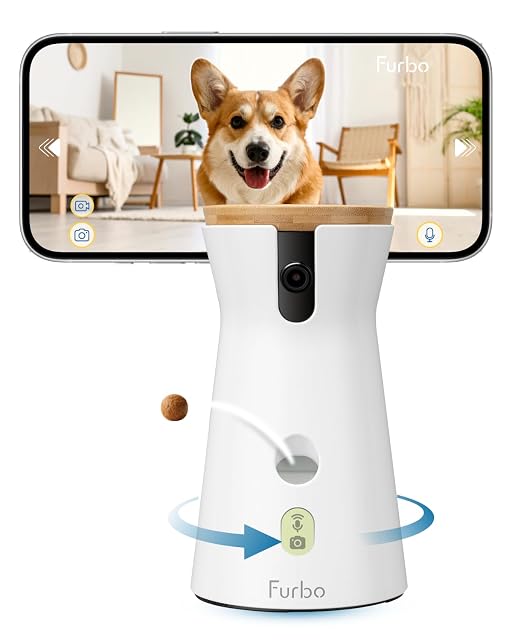
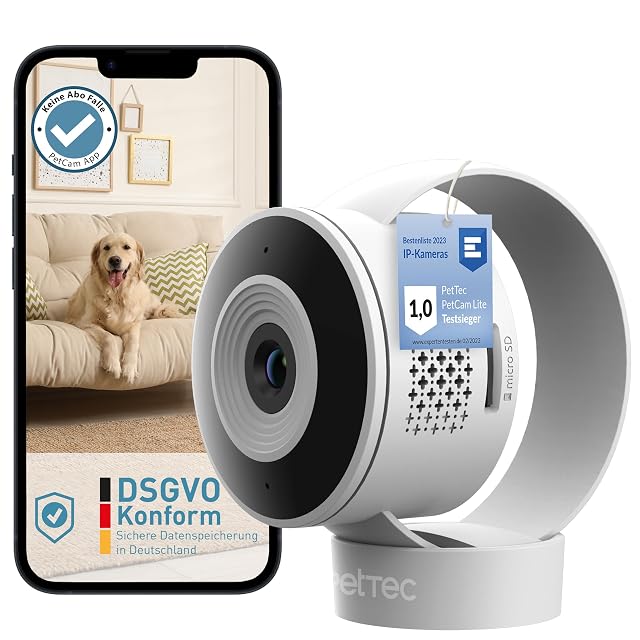
This is the only camera in the American survey that ships with the card installed. The PETLIBRO feeder-camera on this shelf has a slot and no card; the Petcube and the Furbo have neither. Thirty-two gigabytes is not much at 2.5K, but it is yours, and no bullet on this listing mentions a subscription at all.
Self-docking, with the limitation published
“When battery runs low, ROLA PetPal auto-docks and recharges.”
And then, unusually honest, a second bullet headed Pro Tip: “ROLA PetPal uses infrared to find its dock, so return may fail if in separate rooms. For reliable docking, we recommend driving it near its dock after use.”
Infrared is line-of-sight. A robot that has driven into the bedroom cannot see a dock in the hall, and the listing says so rather than leaving you to discover it. Treat the self-docking as a convenience within one room, not as a guarantee.
2.5K, the highest resolution on this page
Against 2K on the Geeni and 1080p on everything else. On a moving camera that resolution is doing real work: a driven image shakes, and pixels are what survive the shake.
No field of view is published, which on a camera that turns its whole body matters less than on a fixed one.
The treat dispenser is a module, and so is the toy
“Treat Dispenser & Modular Design… add the optional Interactive Module (sold separately).”
The treat module is included. The play module is not, and its price is not published. A modular design is also a design with more joints to fail.
What is not published
No battery life, no run time, no field of view, no treat capacity, no treat size range, no audio latency, and no price for the interactive module. For a battery-powered device, the missing run time is the real gap: a robot that needs the dock every twenty minutes is a different product from one that lasts an afternoon.
Availability
Read on the day this page was built: $200 at the American Amazon shop.
Read from Keepa on the day this page was last revised; stock and price both move without notice.
Prices quoted in this text were read on 2026-10-06. The live price is at the top of the page.