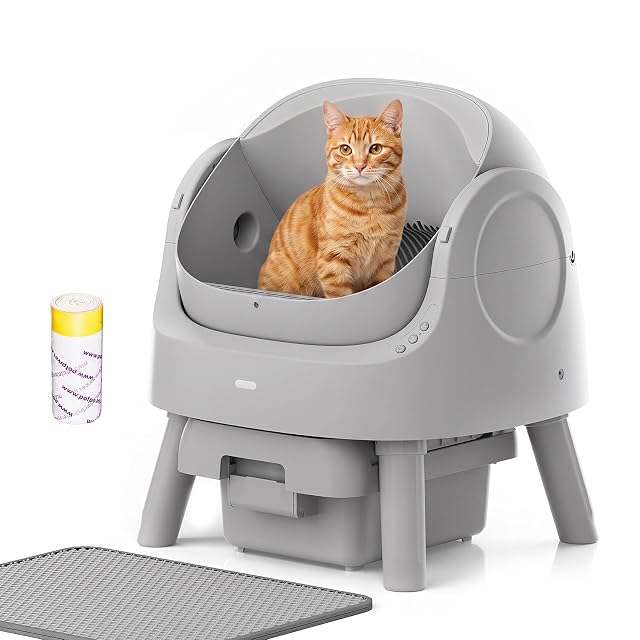
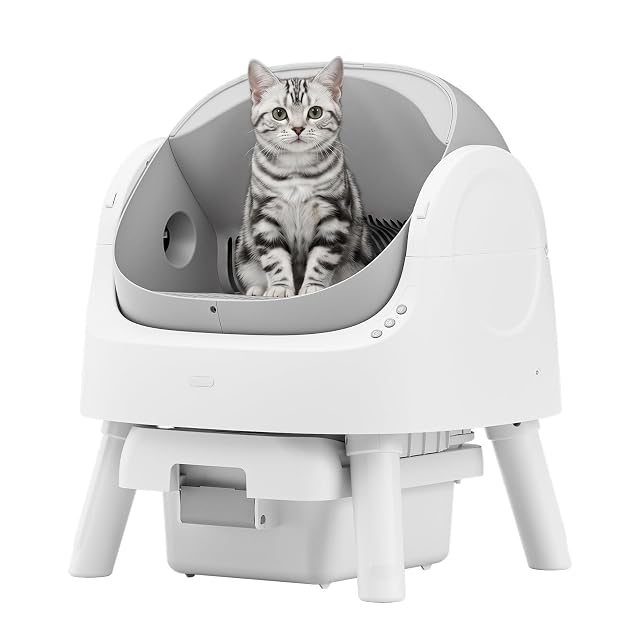
An open-topped drum box for cats that refuse enclosed machines, with the widest stated weight range here — up to 15 kg (33.1 lb) — and 6 infrared plus 4 weight sensors watching the cycle.
What we take from it The box for a big cat or a wary one. You trade some odor containment and a couple of decibels for a shape cats accept quickly and a genuinely large waste bin.
What it is
A drum box with the top left open. There is no hood and no tunnel: the cat
steps in as it would on a tray, and the drum turns after it leaves.
The argument for an open design
The most expensive failure in this whole category is a box the cat refuses.
Enclosed drums ask a cat to walk into a tube with a floor that has moved
before; some cats never accept that. An open machine looks like the tray they
already use, which is why Neakasa leads with the design rather than with the
electronics.
The numbers Neakasa publishes
Cats up to 15 kg (33.1 lb) — the widest range on this page. A 7.17-liter litter chamber
and an 11-liter waste bin, together giving up to 14 days. Six infrared sensors
and four weight sensors, which stop the cycle on contact rather than after it.
Noise at or below 50 dB, and a one-year warranty.
What you give up
Odor containment. A sealed drum keeps smell in the waste box between cycles;
an open one cannot, and relies on the cleaning cycle happening promptly
instead. And litter travels: what a hood would have kept inside ends up on the
floor around the machine, so this is a box for a utility room rather than a
hallway.
Modes
Auto, manual, timer and empty. The empty cycle is the one that matters on a
drum: it turns the whole chamber out when you are changing litter, instead of
you tipping 7 liters of clay into a bag by hand.
What we rate, and what we flag up
Strengths
Open design: the least intimidating shape here for a cat moving off a manual tray
The widest stated weight range on this page — up to 15 kg (33.1 lb) covers the largest breeds
11 L waste bin, the largest here, for up to 14 days
Four cleaning modes including a dedicated empty cycle
Compromises
An open box does less to contain odor between cycles than a sealed drum
≤ 50 dB is the loudest stated figure on this page — quiet, but not the quietest
One-year warranty, where some competitors offer longer
Litter travels further out of an open box than out of a hooded one
Specifications
Design
Open top — no hood, no tunnel
Cat weight
Up to 15 kg (33.1 lb) (Neakasa figure)
Capacity
7.17 L litter chamber, 11 L waste bin — up to 14 days
Sensors
6 infrared and 4 weight sensors
Modes
Auto, manual, timer, empty
Noise
≤ 50 dB (Neakasa figure)
Warranty
1 year
Manufacturer reference
PS0121WE
Amazon reference
B0DG59SQ5P (identical on 6 markets)
EAN
0198715779851
The questions owners ask
Why choose an open box over an enclosed one?
Because a significant number of cats will not use an enclosed one. A cat that has always used an open tray sees a hooded drum as a tunnel with a moving floor, and refusal is the most expensive outcome in this category. If your cat is at all cautious, an open design is the safer purchase even though it contains less odor.
Is 15 kg (33.1 lb) a realistic limit?
It is Neakasa’s stated figure, and it is the highest here — most boxes on this page stop at 8 to 12.5 kg (17.6 to 27.6 lb). For a Maine Coon or a large mixed breed, that headroom is the specification that decides between this and everything else.
How often does the bin need emptying?
Neakasa gives up to 14 days from the combination of a 7.17 L litter chamber and an 11 L waste bin. As always that assumes one cat; with two, halve it, and with an open design expect to sweep around the box more often than you empty it.
Our score
8.6/ 10
The box for a big cat or a wary one. You trade some odor containment and a couple of decibels for a shape cats accept quickly and a genuinely large waste bin.
Today’s price and availability, for pet devices
A reference exists on these Amazon stores: France, Germany, Italy, Spain, United Kingdom, United States. Listed is not the same as in stock — availability changes daily.
Details checked on August 17, 2026.
This one and its buyer, among pet devices
A large cat, or a nervous one that will not enter an enclosed machine — and a household that can put the box somewhere the litter scatter does not matter.
Accessories confirmed for this product
Listed because the accessory names this product itself.
Amazon reports what buyers took in the month before this page was last checked: at least 50.
The figure is a floor, rounded by Amazon, and read through Keepa — it says what buyers picked, not what a maker claims.
Sources
Specifications: the manufacturer sheet for pet devices and the matching Amazon product page. Prices and availability: Keepa. Every figure on this page names its source.